


Industry
Healthcare — systems first, AI where it's earned
Healthcare data is high-stakes and heavily regulated, and we treat it that way. Our healthcare work leads with systems integration and data engineering — the connective tissue between EHRs, claims, and operational systems — and we bring AI into the picture only in narrow, auditable places where getting it wrong isn't an option.
Where we work in your stack
Three problems we solve for healthcare organizations
EHR & systems integration
Connecting electronic health record systems, billing platforms, and operational tools without disrupting the clinical workflows that depend on them.
Healthcare data engineering
Pipelines and data models built to the compliance and auditability standards healthcare demands — not retrofitted onto a generic data stack.
Conservative AI applications
Administrative automation, documentation support, and retrieval over internal knowledge bases — deployed only where a human stays in the loop and every output is traceable.
A concrete example
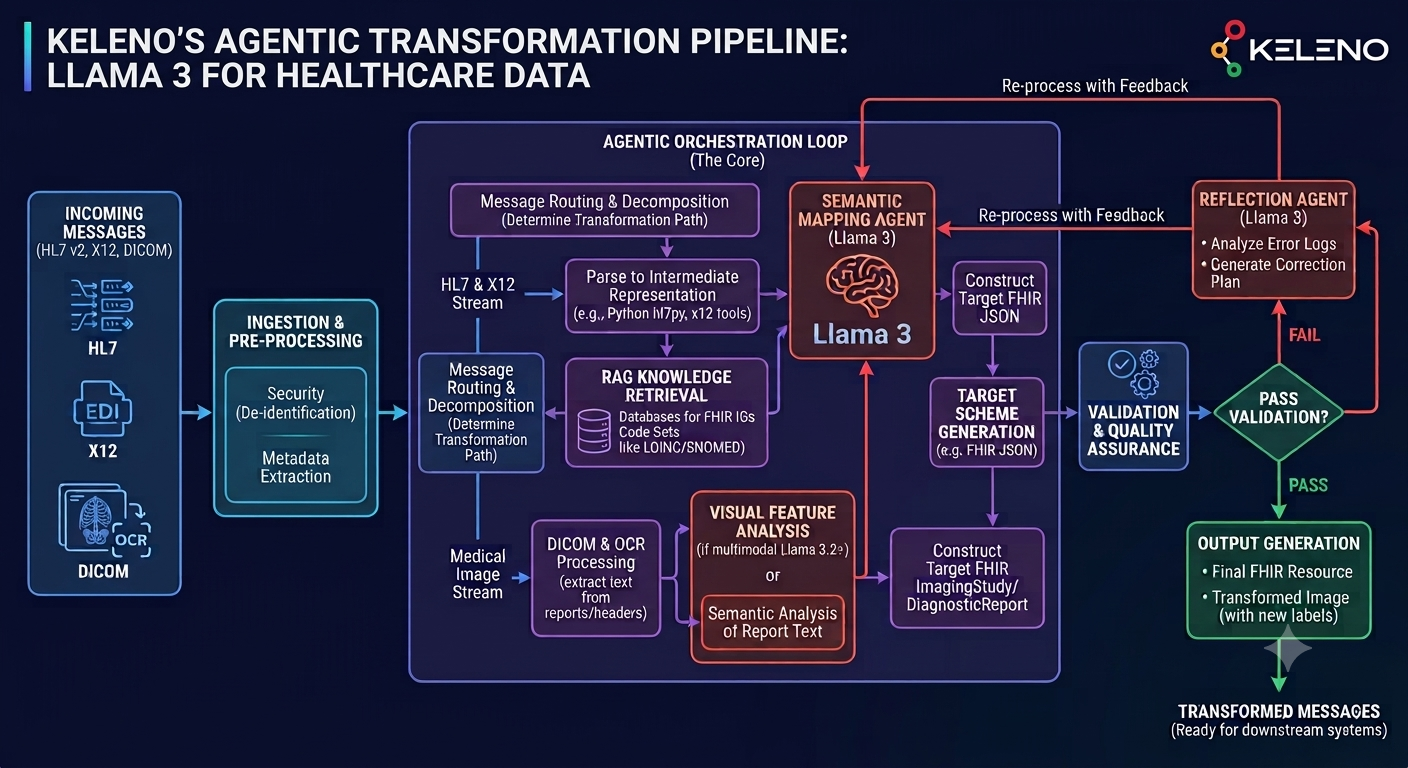
Inside one agentic pipeline: HL7, X12, and DICOM into clean FHIR
The challenge
Building a multi-format transformation agent for healthcare is both high-value and notoriously challenging. Legacy healthcare formats like HL7 v2 and X12 EDI are notorious for “standard” rules that every vendor customizes differently, while FHIR demands strict JSON/XML schema compliance.
Because clinical and financial data require zero-hallucination accuracy, standard end-to-end LLM generation won't suffice. This requires a hybrid agentic lifecycle — combining deterministic parsing tools with Llama 3's semantic reasoning and self-correction loops.
The approach
Incoming HL7, X12, and DICOM messages are de-identified and routed, then a Llama 3 agent maps each one to a target FHIR resource — grounded in a retrieval layer over your FHIR implementation guides and code sets, not the model's memory alone. Every output passes a validation and quality-assurance check before release; anything that fails routes to a reflection agent that reads the error log, proposes a correction, and retries — with a human still in the loop on the exceptions.
Under the hood
The parsing and agent tooling behind it
| Data format | Primary parsing tool | Llama 3 agent role |
|---|---|---|
| HL7 v2.x | hl7py / custom ER7 parser | Resolving custom Z-segments, mapping non-standard local codes to LOINC/SNOMED CT. |
| X12 (837/835) | x12 / pyx12 parser | Untangling complex hierarchical loops (2000A, 2010AA) into FHIR Claim resources. |
| FHIR (R4/R5) | fhir.resources (Pydantic) | Structural validation, generating JSON-LD, handling missing required fields. |
| Medical images | pydicom / OCR / vision model | Extracting DICOM metadata headers, passing pixel data/reports to vision extensions. |
Our process
The 6-Phase Agentic Development Lifecycle
Phase 1
Requirements & Security
Phase 2
Tool & Agent Architecture
Phase 3
Llama 3 Optimization
Phase 6
HIPAA Deployment & Ops
Phase 5
Rigorous Evals & Benchmarks
Phase 4
Self-Correction Loops
A note on how we talk about healthcare AI
We won't claim AI can make clinical decisions, and we're wary of anyone who does. Where we apply AI in healthcare settings, it's scoped to administrative and operational tasks with clear human oversight. We're building out published examples of this work. Ask us for specifics.